🚀 We're Hiring: Laravel Developer in Gandhinagar (Full-Time)
A great career opportunity is available for a skilled backend engineer to join a growing development team in Gandhinagar. If you are passionate about building robust web applications, optimizing databases, and leveraging modern AI-assisted development workflows to write efficient code, Prismetric is actively searching for you!
Hiring for Prismetric.
💼 Position Overview:
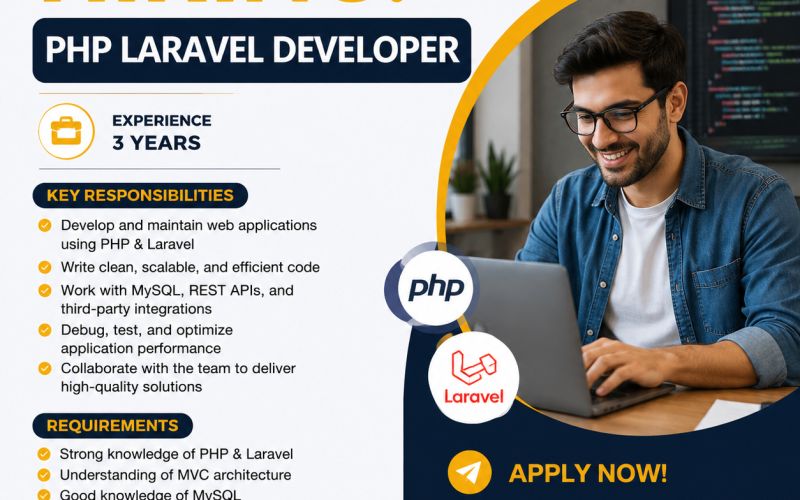
• Position: Laravel Developer (1–4 Years Experience)
• Job Location: Infocity, Gandhinagar, Gujarat (Complete In-Person / Work From Office)
• Job Type: Full-Time, Permanent
• Salary Framework: ₹2,50,000 - ₹5,00,000 Per Annum (Fixed brackets based on skill assessment)
• Position: Laravel Developer (1–4 Years Experience)
• Job Location: Infocity, Gandhinagar, Gujarat (Complete In-Person / Work From Office)
• Job Type: Full-Time, Permanent
• Salary Framework: ₹2,50,000 - ₹5,00,000 Per Annum (Fixed brackets based on skill assessment)
⚙️ Roles & Responsibilities:
As a Laravel Developer at Prismetric, your core day-to-day responsibilities will include:
• Designing, developing, testing, and maintaining high-quality web applications using PHP and Laravel.
• Architecting, optimizing, and writing efficient MySQL database queries and schemas.
• Developing, testing, and integrating secure, high-performance RESTful APIs.
• Identifying bugs, troubleshooting technical roadblocks, and optimizing code performance.
• Utilizing modern AI-assisted development tools (like Windsurf and Cursor) to accelerate engineering pipelines.
• Collaborating closely with cross-functional teams to deploy software patches and new features securely.
📌 Technical Skills Required:
• Core Backend: Strong core fundamentals of PHP and hands-on experience with the Laravel Framework (MVC architecture).
• Database Layer: Proficient knowledge of relational databases, specifically MySQL indexing and query tuning.
• AI Workflows: Hands-on familiarity with modern AI code editors like Windsurf and Cursor to speed up logic building.
• Version Control & Security: Practical understanding of version control system workflows using Git, core web security protocols, and performance optimization.
Top 10 Advanced Laravel & AI-Assisted Workflows Q&As (1–4 Years Experience)
Q1. How do you leverage AI code editors like Cursor or Windsurf safely without introducing structural bugs or security debt?
Ans. AI-assisted editors are powerful for boilerplate generation, but raw copy-pasting introduces vulnerabilities. Senior engineers use Cursor's codebase indexing (@Codebase) to contextually generate code that aligns with existing app architecture. Every AI-generated query must be verified manually to prevent unoptimized loops, and all input variables must pass standard Laravel validation array rules.
Ans. AI-assisted editors are powerful for boilerplate generation, but raw copy-pasting introduces vulnerabilities. Senior engineers use Cursor's codebase indexing (@Codebase) to contextually generate code that aligns with existing app architecture. Every AI-generated query must be verified manually to prevent unoptimized loops, and all input variables must pass standard Laravel validation array rules.
Q2. What is the operational purpose of Service Containers and Service Providers inside Laravel?
Ans. The Service Container is a powerful container bucket used to manage class dependencies and perform automated dependency injection. Service Providers are the central bootstrap mechanism; they run sequentially during application initialization to register service scopes, boot up route parameters, and bind interface abstractions inside the container before processing incoming HTTP request loops.
Ans. The Service Container is a powerful container bucket used to manage class dependencies and perform automated dependency injection. Service Providers are the central bootstrap mechanism; they run sequentially during application initialization to register service scopes, boot up route parameters, and bind interface abstractions inside the container before processing incoming HTTP request loops.
Q3. How do you implement robust database transaction handling inside multi-table data processing logic?
Ans. Database transactions ensure data consistency across multiple write operations. They are handled by wrapping queries inside the native DB::transaction(function () { ... }) callback block. If any nested query triggers an runtime exception, the entire execution layer automatically rolls back safely, blocking partial database corruption.
Ans. Database transactions ensure data consistency across multiple write operations. They are handled by wrapping queries inside the native DB::transaction(function () { ... }) callback block. If any nested query triggers an runtime exception, the entire execution layer automatically rolls back safely, blocking partial database corruption.
Q4. What is the difference between Lazy Loading and Eager Loading in Laravel Eloquent, and how do you monitor it?
Ans. Lazy Loading loads related model records only when they are explicitly accessed, which triggers the dangerous 'N+1 query problem' inside rendering loops. Eager Loading uses the 'with()' helper method to fetch parent and related records together in a single query chain. We monitor this during development by enabling the strict Model::preventLazyLoading() constraint.
Ans. Lazy Loading loads related model records only when they are explicitly accessed, which triggers the dangerous 'N+1 query problem' inside rendering loops. Eager Loading uses the 'with()' helper method to fetch parent and related records together in a single query chain. We monitor this during development by enabling the strict Model::preventLazyLoading() constraint.
Q5. How do you handle continuous relational database table modifications cleanly inside scaling team workflows?
Ans. Database structures are managed using Database Migrations. Instead of executing manual raw SQL adjustments on production database cells, developers write structured PHP migration classes that define changes sequentially. This layout allows for seamless schema syncing across staging and live production systems while maintaining roll-back safety paths.
Ans. Database structures are managed using Database Migrations. Instead of executing manual raw SQL adjustments on production database cells, developers write structured PHP migration classes that define changes sequentially. This layout allows for seamless schema syncing across staging and live production systems while maintaining roll-back safety paths.
Q6. Explain the practical execution difference between utilizing Laravel Gates vs Policy abstraction modules.
Ans. Gates are abstract, closure-based authorization checks registered globally inside service providers, best suited for generic standalone features (e.g., accessing an internal admin dashboard panel). Policies are strongly-coupled object arrays mapped directly to specific Eloquent models (e.g., Post or Invoice) to handle micro-level CRUD permission checks.
Ans. Gates are abstract, closure-based authorization checks registered globally inside service providers, best suited for generic standalone features (e.g., accessing an internal admin dashboard panel). Policies are strongly-coupled object arrays mapped directly to specific Eloquent models (e.g., Post or Invoice) to handle micro-level CRUD permission checks.
Q7. How do you implement automated rate-limiting constraints on secure backend RESTful APIs inside Laravel?
Ans. Rate limiting is enforced inside route mapping loops by invoking the native 'throttle' middleware container. Developers can construct custom dynamic rate limiters inside AppServiceProvider using RateLimiter::for(), scaling request boundaries dynamically based on user authentication tokens or IP tracking blocks to prevent brute-force attacks.
Ans. Rate limiting is enforced inside route mapping loops by invoking the native 'throttle' middleware container. Developers can construct custom dynamic rate limiters inside AppServiceProvider using RateLimiter::for(), scaling request boundaries dynamically based on user authentication tokens or IP tracking blocks to prevent brute-force attacks.
Q8. What are Accessors and Mutators inside Laravel Eloquent models, and what is their modern syntax?
Ans. Accessors format database column data attributes programmatically upon retrieval (e.g., capitalizing text) without modifying the raw cell values. Mutators intercept and format incoming payload values before they are written into database tables. Modern Laravel uses return Attribute::make(get: fn ($value) => ..., set: fn ($value) => ...) definitions.
Ans. Accessors format database column data attributes programmatically upon retrieval (e.g., capitalizing text) without modifying the raw cell values. Mutators intercept and format incoming payload values before they are written into database tables. Modern Laravel uses return Attribute::make(get: fn ($value) => ..., set: fn ($value) => ...) definitions.
Q9. What problem do Laravel Queues solve, and how are long-running technical tasks handled asynchronously?
Ans. Queues offload time-intensive computing processing tasks (such as dispatching bulk notification emails or converting media attachments) out of the primary synchronous HTTP thread execution loop. These workloads are moved into background queue workers, reducing front-end transaction latency and preventing browser timeout errors.
Ans. Queues offload time-intensive computing processing tasks (such as dispatching bulk notification emails or converting media attachments) out of the primary synchronous HTTP thread execution loop. These workloads are moved into background queue workers, reducing front-end transaction latency and preventing browser timeout errors.
Q10. How does the automated CSRF token verification process intercept cross-site request forgery attacks?
Ans. The global VerifyCsrfToken middleware chain tracks all incoming POST, PUT, and DELETE HTTP verbs. It parses incoming header parameters or hidden form input elements to match encrypted payload tokens against the current verified user session state, automatically blocking unauthorized third-party automated request manipulation.
Ans. The global VerifyCsrfToken middleware chain tracks all incoming POST, PUT, and DELETE HTTP verbs. It parses incoming header parameters or hidden form input elements to match encrypted payload tokens against the current verified user session state, automatically blocking unauthorized third-party automated request manipulation.
🌟 Good to Have (Bonus Skills):
• Caching mechanisms using Redis clusters to lower page latency.
• Containerization workflows using Docker containers for platform portability.
• Understanding of DevOps pipelines, specifically automated CI/CD setups.
• Writing automated unit or feature testing scripts.
• Caching mechanisms using Redis clusters to lower page latency.
• Containerization workflows using Docker containers for platform portability.
• Understanding of DevOps pipelines, specifically automated CI/CD setups.
• Writing automated unit or feature testing scripts.
📋 Selection & Interview Process:
• Phase 1: Resume Evaluation – Initial shortlisting based on experience matrices and core tech stack match.
• Phase 2: Technical Task – A practical machine coding assessment focusing on Laravel logic, API development, and query optimization loops.
• Phase 3: Technical Interview Panel – An in-depth face-to-face evaluation covering MVC architecture patterns, web security, and relational databases.
• Phase 4: HR Round – Final conversation focusing on culture alignment, workplace office rules compliance, and compensation structuring.
🎁 Perks & Benefits:
• Modern Tech Culture: Work directly with bleeding-edge AI-assisted development workflows (Cursor/Windsurf).
• Professional Upgradation: Excellent mentorship paths supervised directly by seasoned software architecture leads.
• Structured Appraisal: Fast-paced performance-based salary hikes, clear career progression tracking, and incentive tracks.
📩 How to Apply:
Know a fellow backend engineer looking for a modern Laravel developer role in Gandhinagar? Share this opportunity with them!