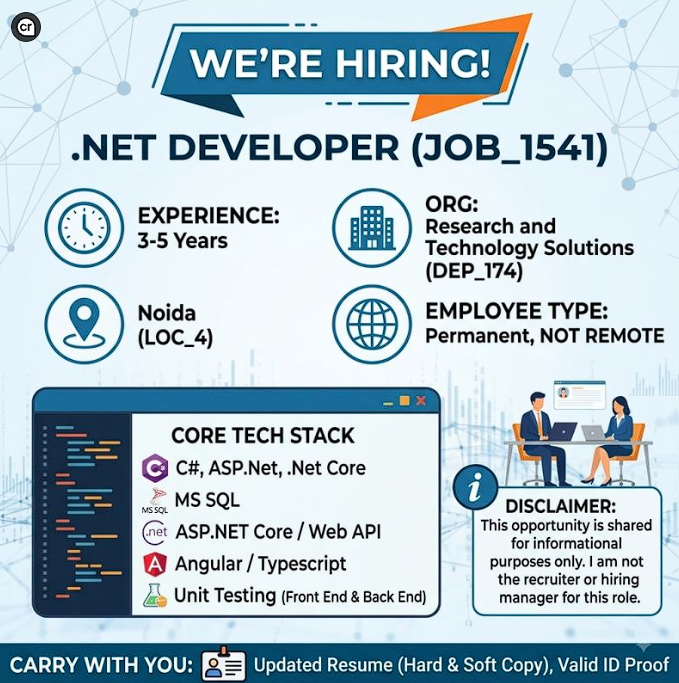
🚀 We're Hiring: .NET Developer in Noida (3–5 Years Experience Required)
👉 Apply Here
Are you an agile and logical software engineer looking to build scalable, high-performance web applications and design robust enterprise architectures? A premier technological software development agency is actively seeking a talented and driven Mid-Level .NET Developer to join its expanding in-house engineering team on-site in Noida. This full-time, permanent career opportunity is specifically tailored for developers with 3 to 5 years of professional experience who want to dive deep into the Microsoft Dot Net ecosystem and manage cloud-ready enterprise applications.
Hiring for a reputed software development agency.
💼 Detailed Position Overview:
Our Research and Technology Solutions team (DEP_174) in Noida is growing and looking for permanent, on-site talent. We need someone who can dive deep into the Microsoft Dot Net ecosystem and build scalable, enterprise-level applications.
• Role: .NET Developer (DEP_174 Team)
• Experience Required: 3 - 5 Years working on Microsoft Dot Net based applications.
• Job Location: Noida (LOC_4) – Permanent, On-Site (Non-Remote)
• Employment Type: Full-Time, Permanent
• Job ID: JOB_1541
⚙️ Core Roles & Responsibilities:
As a Mid-Level .NET Developer, your daily technical and architectural tasks will include:
• Designing, coding, testing, debugging, and maintaining robust web-based applications using C# and .NET Core frameworks.
• Implementing clean backend architectures using ASP.NET MVC and writing highly scalable server-side logical workflows.
• Building Enterprise level Front End applications using Angular (Typescript).
• Developing, standardizing, testing, and integrating highly secure RESTful Web APIs and modern enterprise microservices.
• Writing comprehensive unit tests for both Front End and Back End layers to ensure software quality.
📌 Technical Skills & Profile Required:
Candidates applying for this Noida-based software opening must possess the following domain competencies:
• Backend Mastery: Strong knowledge of OOPS, .Net concepts, C#, ASP.Net, .Net Core, and MS SQL Server.
• API Expertise: Good knowledge of ASP.NET Core framework and Web API concepts.
• Frontend Skills: Experience building Enterprise level Front End applications using Angular (Typescript).
• Quality Focused: Proven experience in writing unit tests for both Front End and Back End layers.
📩 How to Apply:
Interested and qualified software developers can share their updated profiles directly using the link below:
👉 Click Here to Apply for .NET Developer Job in Noida
📋 Top 10 .NET Interview Questions & Answers (5–10 Years Experience)
To help candidates clear technical screening rounds for enterprise positions, our engineering panel has curated the top 10 advanced .NET interview questions with detailed industry-grade answers.
Q1. What is the difference between .NET Framework and .NET (Core/5/6/7/8+)?
Ans. .NET Framework is primarily a Windows-based legacy framework used for building applications such as ASP.NET MVC, Web Forms, and Windows applications. Modern .NET is cross-platform, open-source, and supports Windows, Linux, and macOS. It provides better performance, built-in dependency injection, modern APIs, cloud-native capabilities, and improved support for containers and microservices. For new applications, modern .NET is generally preferred over the legacy framework.
Q2. What is Dependency Injection in .NET, and why is it important?
Ans. Dependency Injection (DI) is a design pattern where a class receives its dependencies from an external source instead of creating them internally. In ASP.NET Core, DI is built natively into the framework. It provides loose coupling, better unit testing capabilities, easier codebase maintenance, and clean separation of concerns.
Example:
public class UserController {
    private readonly IUserRepository _repository;
    public UserController(IUserRepository repository) {
        _repository = repository;
    }
}
Q3. What is the difference between Singleton, Scoped, and Transient services?
Ans. These represent service lifetimes in the framework:
• Transient: Creates a new instance every single time it is requested by the application.
• Scoped: Creates one instance per unique HTTP request lifecycle (commonly used for Entity Framework DbContext).
• Singleton: Creates a single instance for the application's entire runtime lifetime and shares it.
Q4. How do you improve the performance of a .NET Web API?
Ans. Optimization requires targeting multiple layers:
• Implement asynchronous programming heavily using async/await structures.
• Optimize database execution plans, apply database indexing, and avoid unnecessary Include() operations.
• Implement response caching, compress structural payloads, and return minimal fields using DTOs.
• Offload long-running computing cycles to background execution workers and use connection pooling.
Q5. What is the difference between IEnumerable, IQueryable, and List?
Ans.
• IEnumerable: Used for executing LINQ operations in-memory on data sets that are already loaded locally.
• IQueryable: Designed for querying remote data sources like databases; translates expressions directly into optimized SQL queries.
• List: A concrete in-memory collection that stores the actual executed data values physically. Calling ToList() too early loads the entire dataset before filtering.
Q6. How does async/await work in .NET?
Ans. It is used for non-blocking asynchronous I/O-bound operations (database queries, network requests). The async/await pattern does not automatically spawn new background threads; instead, it yields the current thread execution back to the pool while waiting for the network card or disk to respond, dramatically scaling concurrency limits.
Q7. What is Middleware in ASP.NET Core?
Ans. Middleware represents specialized code components injected into the application's HTTP request and response pipeline. They execute sequentially to handle overarching parameters like exception logging, user authentication checking, CORS rules evaluation, and localized routing adjustments.
Q8. How do you handle exceptions globally in ASP.NET Core?
Ans. Instead of polluting controllers with repetitive try-catch blocks, centralized global exception handling middleware is implemented using app.UseExceptionHandler("/error"). It intercepts unhandled application runtime crashes, logs the trace safely, and surfaces standardized, clean HTTP error payloads back to clients without exposing core system code.
Q9. How would you secure a .NET Web API?
Ans. Security requires a multi-layered defensive blueprint:
• Enforce JWT token authentication or robust OAuth 2.0/OpenID Connect identity layers.
• Implement strict role-based or policy-based authorization rules on endpoints using [Authorize] attributes.
• Use parameterized queries via EF Core to block SQL injection and set up secure secret management.
Q10. How would you design a scalable .NET application for millions of users?
Ans. The global system architecture must scale horizontally by separating components:
• Utilize an upfront Load Balancer to route traffic across stateless ASP.NET Core application nodes.
• Introduce Redis distributed caching networks to offload direct transactional read pressures from primary SQL databases.
• Deploy background queuing layers (RabbitMQ/Kafka) to execute intensive computations asynchronously.
⭐ Important Topics to Prepare for 5–10 Years Experience:
Apart from these 10 questions, prepare strongly for ASP.NET Core architecture, Web API optimization, Entity Framework Core query tuning, complex LINQ queries, SQL optimization, SOLID principles, and clean system design patterns.