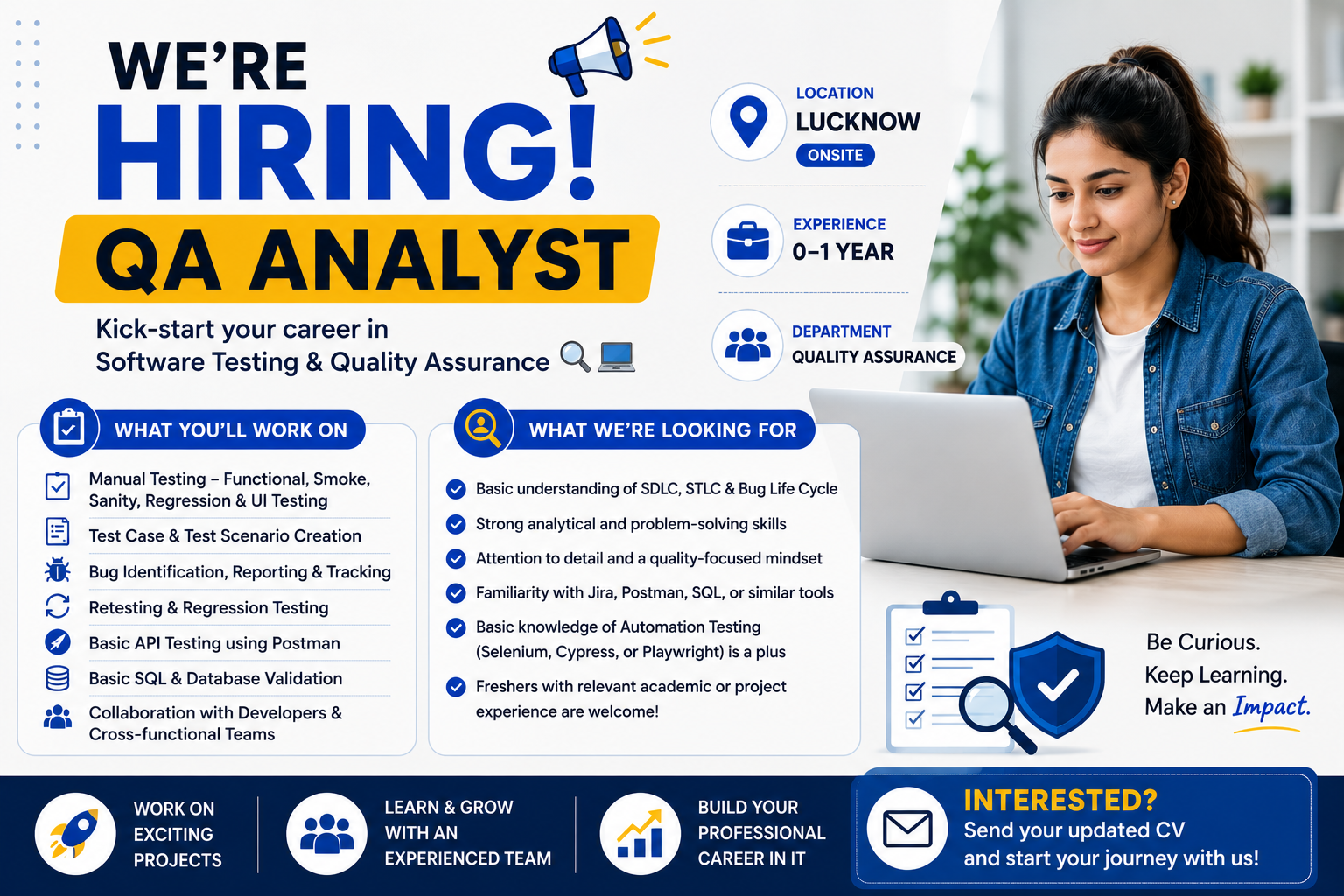
🚀 We're Hiring: QA Analyst in Lucknow (Freshers Can Apply!)
Are you an analytical thinker with a sharp eye for detail, structural code flow, and a passion for ensuring software quality? Webcotec Technology is actively searching for a motivated, driven, and enthusiastic Junior QA Analyst (Quality Assurance) to join our expanding in-house software testing division on-site in Lucknow, Uttar Pradesh. This entry-level career opportunity is specifically designed for engineering graduates and freshers with 0 to 1 year of experience who want to gain deep production exposure, master modern manual testing methodologies, and grow under senior technical mentorship.
Hiring for webcotec technology
💼 Position Overview:
• Role: QA Analyst / Software Test Engineer
• Experience Required: 0 - 1 Years (Freshers with manual testing certifications are highly preferred)
• Job Location: Gomti Nagar, Lucknow, Uttar Pradesh (Complete On-Site / Work From Office)
• Employment Type: Full-Time, Permanent
• Salary Framework: ₹1,80,000 - ₹2,80,000 Per Annum (Based on skill evaluation rounds)
⚙️ Core Roles & Responsibilities:
As a Junior QA Analyst in our Lucknow software testing hub, your daily execution targets will include:
• Executing comprehensive manual test cases across complex web applications to identify runtime user interface defects.
• Writing clear, detailed, and structured test scenarios, functional test cases, and error log datasets.
• Documenting, tracking, and reporting software bugs with precise steps to reproduce inside standard logging tools.
• Performing structural functional, regression, smoke, and sanity testing iterations before final product deployment phases.
• Conducting basic API testing using modern cross-platform utility toolkits to validate structural backend JSON responses.
• Running fundamental SQL verification queries to check database cell consistency, foreign key mappings, and data integrity.
• Collaborating closely with backend PHP/Laravel developers, frontend UI engineers, and automated testing QA leads.
📌 Technical Skills & Profile Required:
Candidates applying for this Lucknow-based software testing opening must possess the following domain competencies:
• System Foundations: Strong conceptual understanding of the Software Development Life Cycle (SDLC) and Software Testing Life Cycle (STLC).
• Testing Methodologies: Solid grasp of manual testing concepts, boundary value analysis, equivalence partitioning, and bug lifecycles.
• Tool Comfort: Basic familiarity operating web application inspection panels and testing endpoints using Postman configurations.
• Database Basics: Elementary knowledge of relational databases and executing basic validation queries inside MySQL or SQL Server.
• Logical Mindset: Exceptional logical debugging habits, strong analytical thinking, and great written communication for bug logging.
• Preferred Assets: A certified manual testing course completion validation or structural academic project testing history is highly preferred.
Top 10 Manual Testing & SQL Interview Q&As for Freshers
To help entry-level tech graduates successfully clear the screening pipelines, our engineering QA leads have compiled the essential interview questions:
Q1. What is the difference between Verification and Validation in software testing?
Ans. Verification evaluates software artifacts (documents, designs, code blocks) during development phases to ensure system specifications are met (Static Testing). Validation evaluates the final operational software product to verify it fulfills the target business requirements (Dynamic Testing).
Q2. What is the exact difference between Smoke and Sanity testing?
Ans. Smoke testing checks the structural stability of an initial new build layout by testing all core critical functionalities end-to-end. Sanity testing is performed on a stable build containing minor bug fixes to verify that specific components operate correctly without breaking adjacent routines.
Q3. What parameters constitute a comprehensive, high-quality Bug Report?
Ans. A professional bug logging layout requires a unique Bug ID, descriptive Title, Severity/Priority metrics, Environment details (OS/Browser), absolute Steps to Reproduce, Expected vs Actual Output, and attached visual Proofs (Screenshots or Trace logs).
Q4. Explain the difference between Boundary Value Analysis (BVA) and Equivalence Partitioning.
Ans. Equivalence Partitioning divides input datasets into valid and invalid logical classes to test single representative inputs. Boundary Value Analysis focuses strictly on evaluating system behavior at the marginal limits of these classes (e.g., Minimum, Maximum, and boundary edges).
Q5. What is a Bug Lifecycle inside an agile enterprise workspace environment?
Ans. When a bug is discovered, its state transitions sequentially through: New -> Assigned -> Open -> Fixed -> Pending Retest -> Retest -> Verified -> Closed. If the issue persists during retesting, its status changes back to Reopened.
Q6. What is the difference between a Clustered and a Non-Clustered Index in SQL?
Ans. A Clustered Index physically re-orders the actual rows inside the database table based on the key value (only one allowed per table). A Non-Clustered Index builds a separate logical lookup pointer array pointing to data blocks, similar to an index at the back of a book.
Q7. How do you fetch duplicate records from an application database table in MySQL?
Ans. Duplicate records are tracked by grouping matching data columns and applying a filter using the HAVING clause. Example query syntax: SELECT user_email, COUNT(*) FROM users GROUP BY user_email HAVING COUNT(*) > 1;
Q8. What is the primary operational difference between the DELETE and TRUNCATE commands?
Ans. DELETE is a Data Manipulation Language (DML) command that removes rows sequentially based on a WHERE condition and can be rolled back. TRUNCATE is a Data Definition Language (DDL) command that drops the entire physical data page structure, cannot be rolled back easily, and runs significantly faster.
Q9. How do you execute API response validation checks inside Postman?
Ans. In the Postman interface, scripts are written inside the 'Tests' tab using JavaScript frameworks. We validate response status codes using the PM API structure: pm.test("Status is 200", function () { pm.response.to.have.status(200); });
Q10. What is Retesting vs Regression testing in product release cycles?
Ans. Retesting runs tests strictly on specific failed cases to confirm a particular developer fix is operational. Regression testing scans the broader adjacent system modules to ensure that code changes or bug adjustments have not broken existing functional features.
📋 Selection & Interview Process:
Our recruitment workflow for this fresher Software Testing opening at Webcotec Technology involves:
• Phase 1: Profile Screening – Evaluating profiles based on technical self-projects, manual testing certifications, and academic performance matrices.
• Phase 2: Written Aptitude & Logic Evaluation – A time-bound practical round testing error detection ability, system reasoning, and basic SQL loops.
• Phase 3: Technical Panel Deep Dive – An in-depth face-to-face round covering STLC documentation rules, real-world test case writing, and database constraints.
• Phase 4: HR Closing – Final conversation focusing on office schedule compliance, workplace culture fitment, and formal package structuring.
🎁 Perks & Benefits:
• Guidance Curve: Learn immense industry knowledge by collaborating face-to-face with seasoned automation architects and QA leads.
• Fast-Track Appraisals: Benefit from clear, transparent performance-based career progression tracking and semi-annual appraisal tracks.
• Progressive Work Culture: Work within a modern, highly supportive, legally clean, and technically progressive physical corporate office workspace.
📩 How to Apply:
Know a fresher looking to secure their first full-time Software Testing (QA) job with excellent learning prospects in Lucknow? Share this career opportunity with them!